
Learning Swedish becomes easier when you know what to say in everyday situations. You don’t need to master grammar before you greet someone, order a coffee or ask for directions. A few useful phrases can help you start conversations and understand the replies you hear.
This guide covers more than 100 basic Swedish phrases for beginners, with simple pronunciation guides and examples of when to use each phrase. You’ll learn Swedish greetings, polite expressions, small talk, shopping vocabulary and phrases for healthcare situations. You’ll also see common replies, so you can follow conversations rather than memorise one side of them.
Start with a few phrases that you can use today. Then add more as you become comfortable speaking Swedish.
The 20 Swedish phrases to learn first
These everyday Swedish phrases give you a starting point for conversations. Practise them aloud and try using one or two whenever you have the opportunity.
| Swedish | Say it like | English | When to use |
|---|---|---|---|
| Hej! | hey | Hello! | Most everyday greetings |
| Hej hej! | hey hey | Hi! / Bye! | Casual greetings and farewells |
| God morgon! | goo MOR-on | Good morning! | In the morning |
| Hur mår du? | huur mohr doo | How are you? | Asking how someone feels |
| Jag mår bra. | yah mohr brah | I’m doing well. | Answering a greeting |
| Tack! | tahk | Thank you! | Showing appreciation |
| Tack så mycket! | tahk soh MICK-et | Thank you very much! | Expressing extra thanks |
| Varsågod. | var-shoh-GOOD | You’re welcome. / Here you go. | Responding to thanks or handing something over |
| Ursäkta. | oor-SEK-tah | Excuse me. | Getting someone’s attention |
| Förlåt. | fur-LOAT | Sorry. | Apologising |
| Ja. | yah | Yes. | Agreeing |
| Nej. | nay | No. | Disagreeing |
| Ja, gärna. | yah YAIR-nah | Yes, please. | Accepting an offer |
| Nej, tack. | nay tahk | No, thank you. | Politely declining |
| Jag heter … | yah HAY-ter | My name is … | Introducing yourself |
| Jag kommer från … | yah KOM-er frohn | I’m from … | Talking about where you come from |
| Jag förstår inte. | yah fur-STOHR IN-teh | I don’t understand. | When you need clarification |
| Kan du hjälpa mig? | kan doo YEL-pah may | Can you help me? | Asking for help |
| Kan du säga det igen? | kan doo SAY-yah deh ee-YEN | Can you say that again? | Asking someone to repeat something |
| Hej då! | hey doh | Goodbye! | Ending a conversation |
For a structured introduction to the language, explore our Swedish for beginners guide or:
start learning with a Swedish A1 course
Hello in Swedish: hej, hej hej, hallå, tja
Swedish greetings change with the situation, but you can use hej in almost any everyday interaction. Say it when you enter a shop, meet a colleague or greet someone you’ve met before.
| Swedish | Say it like | English | When to use |
|---|---|---|---|
| Hej! | hey | Hello! | Everyday greeting |
| Hej hej! | hey hey | Hi! / Bye! | Friendly, casual interactions |
| Hallå! | hah-LOH | Hello! | Calling out or greeting someone casually |
| Tja! | shah | Hey! | Informal conversations with friends |
| Tjena! | SHAY-nah | Hey! | Casual greeting |
| Läget? | LEH-get | What’s up? | Informal small talk |
Good morning, good evening and good night
Swedish uses different expressions for greeting someone during the day and wishing them a good night.
| Swedish | Say it like | English | When to use |
|---|---|---|---|
| God morgon! | goo MOR-on | Good morning! | Morning greetings |
| God dag! | goo dahg | Good day! | A more formal or traditional greeting |
| God kväll! | goo kvel | Good evening! | Evening greetings |
| God natt! | goo naht | Good night! | Before someone goes to sleep |
| Sov gott! | sohv gott | Sleep well! | Wishing someone a good night’s sleep |
Goodbye in Swedish: hej då, vi ses, ha det bra
You can also use hej då in most situations. Try these alternatives when you want to vary your language.
| Swedish | Say it like | English | When to use |
|---|---|---|---|
| Hej då! | hey doh | Goodbye! | General farewell |
| Vi ses! | vee says | See you! | When you expect to meet again |
| Vi ses snart! | vee says snart | See you soon! | When you’ll meet soon |
| Ha det bra! | hah deh brah | Take care! | Friendly farewell |
| Ha en bra dag! | hah en brah dahg | Have a good day! | Leaving a shop or workplace |
| Trevlig helg! | TRAYV-lig helg | Have a nice weekend! | On Friday or before a weekend |
Du or ni? Formal and informal Swedish
In modern Swedish, people generally use du when speaking directly to one person. You can use it with colleagues, shop assistants, teachers and people you meet for the first time. Swedish speakers rarely need a formal alternative in ordinary conversation.
Ni can address more than one person. Some speakers also use it as a formal singular form, but this can sound unusual or overly formal in certain situations. When in doubt, use du for one person.

How are you in Swedish, and how to answer
Hur mår du? vs Hur är läget?
Both questions can start a conversation, but they don’t always carry the same tone. Hur mår du? asks how someone feels, while Hur är läget? sounds closer to “How’s it going?”
| Swedish | Say it like | English | When to use |
|---|---|---|---|
| Hur mår du? | huur mohr doo | How are you? | Asking about someone’s wellbeing |
| Hur är läget? | huur air LEH-get | How’s it going? | Casual conversation |
| Hur går det? | huur gohr deh | How’s it going? | Asking how something is progressing |
| Allt bra? | ahlt brah | Is everything good? | Casual check-in |
| Vad gör du? | vah geur doo | What are you doing? | Asking about someone’s current activity |
Answers you will hear and can give
You don’t need a long answer every time someone asks how you are. A short response works well in many everyday situations.
| Swedish | Say it like | English | When to use |
|---|---|---|---|
| Bra, tack! | brah tahk | Good, thanks! | A common positive reply |
| Bara bra! | BAH-rah brah | Very well! / All good! | Casual positive reply |
| Det är bra. | deh air brah | It’s good. | General answer |
| Helt okej. | haylt oh-KAY | Quite okay. | When things are fine |
| Så där. | soh dair | So-so. | When things aren’t great or terrible |
| Inte så bra. | IN-teh soh brah | Not so good. | When you’re having a difficult day |
| Själv då? | shelv doh | And you? | Returning the question |
| Det rullar på. | deh RULL-ar poh | Things are moving along. | Casual response about life |
How to introduce yourself in Swedish
You can introduce yourself with a few simple sentences. Learn the sentence patterns first, then replace the details with your own information.
Your name, where you are from and where you live
| Swedish | Say it like | English | When to use |
|---|---|---|---|
| Jag heter Anna. | yah HAY-ter AN-ah | My name is Anna. | Giving your name |
| Vad heter du? | vah HAY-ter doo | What’s your name? | Asking someone’s name |
| Trevligt att träffas. | TRAYV-ligt at TREF-as | Nice to meet you. | Meeting someone |
| Jag kommer från Turkiet. | yah KOM-er frohn TOOR-kee-et | I’m from Turkey. | Talking about your country |
| Var kommer du ifrån? | var KOM-er doo ee-FROHN | Where are you from? | Asking about someone’s background |
| Jag bor i Sverige. | yah boor ee SVAIR-yeh | I live in Sweden. | Talking about where you live |
| Var bor du? | var boor doo | Where do you live? | Asking about someone’s home |
| Jag har bott här i två år. | yah har bott hair ee tvoh ohr | I’ve lived here for two years. | Talking about how long you’ve lived somewhere |
Talking about your work or studies
| Swedish | Say it like | English | When to use |
|---|---|---|---|
| Vad jobbar du med? | vah YOB-bar doo med | What do you do for work? | Asking about someone’s job |
| Jag jobbar som läkare. | yah YOB-bar som LEH-kah-reh | I work as a doctor. | Explaining your profession |
| Jag är student. | yah air stoo-DENT | I’m a student. | Talking about your studies |
| Jag studerar svenska. | yah stoo-DAY-rar SVAIRN-skah | I study Swedish. | Talking about language learning |
| Jag jobbar hemifrån. | yah YOB-bar HEM-ee-frohn | I work from home. | Talking about your work routine |
| Vad studerar du? | vah stoo-DAY-rar doo | What are you studying? | Asking about someone’s education |
Dialogue: meeting a new colleague
Anna: Hej! Jag heter Anna. Vad heter du?
Erik: Hej! Jag heter Erik. Trevligt att träffas!
Anna: Detsamma! Var kommer du ifrån?
Erik: Jag kommer från Göteborg. Själv då?
Anna: Jag kommer från Turkiet, men jag bor i Stockholm nu.
This conversation gives you a simple structure: greet the person, exchange names, ask where they come from, and share a little about yourself.
Polite Swedish phrases: thank you, please and sorry
Polite expressions help you manage everyday interactions. Swedish speakers often keep these expressions short, so you don’t need complicated sentences to sound courteous.
Thank you in Swedish: tack, tusen tack, tack för maten, tack för senast
| Swedish | Say it like | English | When to use |
|---|---|---|---|
| Tack! | tahk | Thanks! | Everyday thanks |
| Tack så mycket! | tahk soh MICK-et | Thank you very much! | Stronger appreciation |
| Tusen tack! | TOO-sen tahk | Thanks a lot! | Expressing gratitude |
| Tack för hjälpen. | tahk fur YEL-pen | Thanks for the help. | After someone helps you |
| Tack för maten. | tahk fur MAH-ten | Thanks for the food. | After a meal |
| Tack för senast. | tahk fur SAY-nast | Thanks for last time. | Acknowledging a recent visit or meeting |
| Tack ändå. | tahk EN-doh | Thanks anyway. | When someone can’t help or fulfil a request |
Please in Swedish: why there is no single word
Swedish doesn’t have one direct equivalent of English “please” that fits every situation. Instead, speakers often use a polite question or phrase.
| Swedish | Say it like | English | When to use |
|---|---|---|---|
| Kan jag få ett glas vatten? | kan yah foh et glahs VAT-en | Can I have a glass of water? | Making a request |
| Skulle du kunna hjälpa mig? | SKULL-eh doo KUN-ah YEL-pah may | Could you help me? | Making a polite request |
| Kan du vara snäll och vänta? | kan doo VAH-rah snel oh VENT-ah | Could you please wait? | Asking someone to wait |
| Gärna. | YAIR-nah | Gladly. / Yes, please. | Accepting an offer |
| Ja, tack. | yah tahk | Yes, please. | Accepting something |
You’re welcome: varsågod, ingen orsak, det var så lite
| Swedish | Say it like | English | When to use |
|---|---|---|---|
| Varsågod. | var-shoh-GOOD | You’re welcome. / Here you go. | Responding to thanks or handing something over |
| Ingen orsak. | IN-gen OO-sahk | No problem. | Responding to thanks |
| Det var så lite. | deh var soh LEE-teh | It was nothing. | Downplaying a small favour |
| Ingen fara. | IN-gen FAH-rah | No worries. | Reassuring someone |
| Det är lugnt. | deh air loongt | It’s fine. | Responding casually |
Sorry and excuse me: förlåt vs ursäkta
Use förlåt when you apologise. Use ursäkta when you want to get someone’s attention, move past them or politely interrupt.
| Swedish | Say it like | English | When to use |
|---|---|---|---|
| Förlåt! | fur-LOAT | Sorry! | Apologising |
| Ursäkta! | oor-SEK-tah | Excuse me! | Getting attention |
| Ursäkta, var ligger stationen? | oor-SEK-tah var LIG-er stah-SHOO-nen | Excuse me, where is the station? | Asking a stranger for directions |
| Förlåt, jag är sen. | fur-LOAT yah air sen | Sorry, I’m late. | Explaining lateness |
| Det gör inget. | deh geur IN-get | It doesn’t matter. | Responding to an apology |
Yes, no and jo
Jo matters because Swedish uses it to contradict a negative question or statement.
| Swedish | Say it like | English | When to use |
|---|---|---|---|
| Ja. | yah | Yes. | Agreeing |
| Nej. | nay | No. | Disagreeing |
| Jo. | yoo | Yes, actually. | Contradicting a negative question |
| Kanske. | KAN-sheh | Maybe. | Showing uncertainty |
| Absolut! | ab-so-LOOT | Absolutely! | Strong agreement |
| Inte riktigt. | IN-teh RICK-tigt | Not quite. | Correcting something gently |
For example:
Du: Du pratar inte svenska? (You don’t speak Swedish?)
Du: Jo, lite! (Yes, I do, a little!)
What to say when you don’t understand
You don’t need to understand every word to keep a conversation going. Asking someone to repeat or explain something gives you more chances to learn.
Asking someone to repeat or slow down
| Swedish | Say it like | English | When to use |
|---|---|---|---|
| Jag förstår inte. | yah fur-STOHR IN-teh | I don’t understand. | When something isn’t clear |
| Kan du upprepa det? | kan doo UP-pray-pah deh | Can you repeat that? | Asking someone to repeat |
| Kan du säga det igen? | kan doo SAY-yah deh ee-YEN | Can you say that again? | Asking for repetition |
| Kan du prata långsammare? | kan doo PRAH-tah LONG-sam-ah-reh | Can you speak more slowly? | When someone speaks too fast |
| Kan du skriva det? | kan doo SKREE-vah deh | Can you write it down? | When you need the written form |
| Vad betyder det? | vah beh-TEE-der deh | What does that mean? | Asking about meaning |
| Hur säger man … på svenska? | huur SAY-yer man poh SVAIRN-skah | How do you say … in Swedish? | Asking for a translation |
| Hur stavar du det? | huur STAH-var doo deh | How do you spell that? | Checking spelling |
Asking what a word means
| Swedish | Say it like | English | When to use |
|---|---|---|---|
| Vad betyder det här ordet? | vah beh-TEE-der deh hair OOR-det | What does this word mean? | Asking about vocabulary |
| Kan du förklara det? | kan doo fur-KLAH-rah deh | Can you explain that? | Asking for clarification |
| Kan du ge ett exempel? | kan doo yeh et ex-EM-pel | Can you give an example? | When you need context |
| Jag lär mig svenska. | yah lair may SVAIRN-skah | I’m learning Swedish. | Explaining your level |
| Jag talar bara lite svenska. | yah TAH-lar BAH-rah LEE-teh SVAIRN-skah | I only speak a little Swedish. | Setting expectations |
When Swedes switch to English: Kan vi prata svenska?
Some people switch to English to make conversation easier. If you want to practise Swedish, you can explain that politely.
| Swedish | Say it like | English | When to use |
|---|---|---|---|
| Kan vi prata svenska? | kan vee PRAH-tah SVAIRN-skah | Can we speak Swedish? | Asking to practise |
| Jag vill gärna öva svenska. | yah vill YAIR-nah EU-vah SVAIRN-skah | I’d like to practise Swedish. | Explaining your goal |
| Du får gärna rätta mig. | doo fohr YAIR-nah RET-ah may | Feel free to correct me. | Inviting feedback |
| Jag förstår mer än jag kan prata. | yah fur-STOHR mare en yah kan PRAH-tah | I understand more than I can speak. | Describing your ability |
| Vi kan ta det på svenska. | vee kan tah deh poh SVAIRN-skah | We can do it in Swedish. | Keeping the conversation in Swedish |
Swedish phrases for cafés, restaurants and fika
Fika means taking a break for coffee, tea or something to eat, often with other people. You can use the following phrases in cafés, bakeries and restaurants.
Ordering: Kan jag få…? and Jag skulle vilja ha…
| Swedish | Say it like | English | When to use |
|---|---|---|---|
| Kan jag få en kaffe? | kan yah foh en KAF-feh | Can I have a coffee? | Ordering coffee |
| Jag skulle vilja ha en te. | yah SKULL-eh VIL-yah hah en tay | I’d like tea. | Making an order |
| En kaffe, tack. | en KAF-feh tahk | A coffee, please. | Placing a simple order |
| Har ni havremjölk? | har nee HAH-ver-myolk | Do you have oat milk? | Asking about milk options |
| Vad rekommenderar du? | vah reh-kom-men-DAY-rar doo | What do you recommend? | Asking for suggestions |
| Kan jag få menyn? | kan yah foh meh-NEEN | Can I have the menu? | Asking to see the menu |
| Finns det något vegetariskt? | finns deh NOH-got veh-geh-TAH-riskt | Is there anything vegetarian? | Checking food options |
| Kan jag få notan? | kan yah foh NOH-tan | Can I have the bill? | Asking to pay |
| Kan vi betala separat? | kan vee beh-TAH-lah seh-pah-RAHT | Can we pay separately? | Splitting a bill |
| Var är toaletten? | var air too-ah-LET-en | Where is the toilet? | Finding the toilet |
Asking for the bill
In Sweden, you can often pay at the counter in a café, while restaurants may bring the bill or ask you to pay at the register. If you’re unsure, ask how to pay.
| Swedish | Say it like | English | When to use |
|---|---|---|---|
| Kan jag betala här? | kan yah beh-TAH-lah hair | Can I pay here? | Asking where to pay |
| Kan jag få kvittot? | kan yah foh KVIT-toht | Can I have the receipt? | Requesting a receipt |
| Ingår kaffe? | IN-gohr KAF-feh | Is coffee included? | Checking what’s included |
| Det var jättegott! | deh var YET-teh gott | That was really good! | Complimenting food |
| Tack för fikat! | tahk fur FEE-kat | Thanks for the fika! | Thanking someone after a coffee break |
Dialogue: ordering at a café
Customer: Hej! Kan jag få en kaffe och en kanelbulle, tack?
Staff: Absolut. Vill du ha något mer?
Customer: Nej tack, det är bra.
Staff: Det blir femtio kronor.
Customer: Kan jag betala med kort?
Staff: Ja, absolut.
Customer: Tack så mycket!
This short dialogue covers greetings, ordering, a follow-up question and payment. Practise it with a friend, then change the order to something you actually like.

Shopping and paying in Swedish
Shopping gives you plenty of opportunities to practise numbers, questions and everyday vocabulary.
Prices, sizes and trying things on
| Swedish | Say it like | English | When to use |
|---|---|---|---|
| Hur mycket kostar den? | huur MICK-et KOSS-tar den | How much does it cost? | Asking about a price |
| Vad kostar det? | vah KOSS-tar deh | How much is it? | Asking the price |
| Finns den i en annan storlek? | finns den ee en AN-nan STOOR-lek | Do you have it in another size? | Shopping for clothes |
| Har ni den i svart? | har nee den ee svart | Do you have it in black? | Asking about a colour |
| Kan jag prova den? | kan yah PROH-vah den | Can I try it on? | Trying on clothes |
| Var är provrummet? | var air PROOV-room-et | Where is the fitting room? | Finding the changing room |
| Jag tittar bara. | yah TITT-ar BAH-rah | I’m just looking. | Responding to a shop assistant |
| Jag tar den här. | yah tar den hair | I’ll take this one. | Choosing an item |
| Har ni öppet idag? | har nee EU-pet ee-DAHG | Are you open today? | Checking opening hours |
Card, Swish and receipts
| Swedish | Say it like | English | When to use |
|---|---|---|---|
| Kan jag betala med kort? | kan yah beh-TAH-lah med kort | Can I pay by card? | Paying for a purchase |
| Tar ni kontanter? | tar nee kon-TAN-ter | Do you accept cash? | Checking payment methods |
| Kan jag få kvittot? | kan yah foh KVIT-toht | Can I have the receipt? | Requesting proof of purchase |
| Vill du ha en påse? | vill doo hah en POH-seh | Would you like a bag? | A question from a cashier |
| Vill du ha kvittot? | vill doo hah KVIT-toht | Would you like the receipt? | A question from a cashier |
| Det blir hundra kronor. | deh bleer HOON-drah KROO-noor | That comes to one hundred kronor. | Hearing the total |
| Jag betalar med Swish. | yah beh-TAH-lar med swish | I’ll pay with Swish. | Paying through the Swedish payment service |
Swish is a widely used mobile payment service in Sweden. It usually requires a Swedish bank account and access to the service, so visitors may need to use a card instead.
Start using Swedish today. Choose a few phrases from this guide, say them aloud and try them in a real situation. When you’re ready to build a stronger foundation:
explore Swedish Brain’s A1 course for structured learning.
Asking for directions and getting around
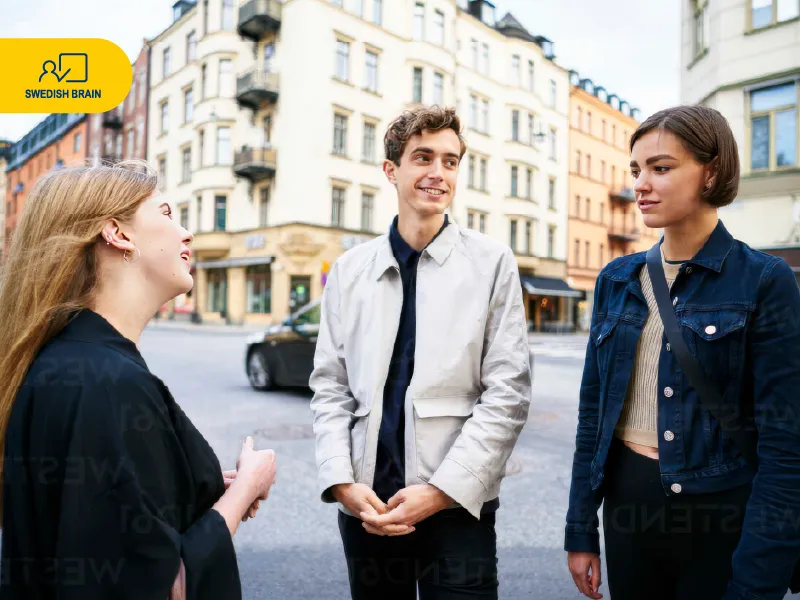
These phrases help you navigate streets, public transport and stations. Start with ursäkta to get someone’s attention, then ask a short question.
| Swedish | Say it like | English | When to use |
|---|---|---|---|
| Var ligger stationen? | var LIG-er stah-SHOO-nen | Where is the station? | Finding a station |
| Hur kommer jag till centrum? | huur KOM-er yah till SEN-troom | How do I get to the centre? | Asking for directions |
| Är det långt härifrån? | air deh longt hair-ee-FROHN | Is it far from here? | Checking distance |
| Är det nära? | air deh NAI-rah | Is it nearby? | Asking if something is close |
| Gå rakt fram. | goh rakt fram | Go straight ahead. | Giving or understanding directions |
| Sväng till vänster. | sveng till VEN-ster | Turn left. | Following directions |
| Sväng till höger. | sveng till HEU-ger | Turn right. | Following directions |
| Var är busshållplatsen? | var air BOOS-holl-plaht-sen | Where is the bus stop? | Finding a bus |
| När går nästa buss? | nair gohr NES-tah boos | When does the next bus leave? | Checking departures |
| Vilken buss ska jag ta? | VIL-ken boos skah yah tah | Which bus should I take? | Planning a journey |
| Var kan jag köpa en biljett? | var kan yah SHEU-pah en bil-YET | Where can I buy a ticket? | Buying public transport tickets |
| Kan du visa mig på kartan? | kan doo VEE-sah may poh KAR-tan | Can you show me on the map? | Asking for visual directions |
Swedish phrases for health and emergencies
If you need medical help in Sweden, use simple, direct language. You don’t need perfect grammar to explain that you feel unwell or need assistance.
Calling for help: 112
Call 112 for emergencies that require immediate assistance from emergency services. For non-emergency healthcare advice, call 1177 or visit 1177.se. You can also contact a vårdcentral for primary care or visit an apotek for pharmacy services.
| Swedish | Say it like | English | When to use |
|---|---|---|---|
| Hjälp! | yelp | Help! | Urgent situations |
| Jag behöver hjälp. | yah beh-HUE-ver yelp | I need help. | Asking for assistance |
| Ring 112! | ring ett-hund-rah-tolv | Call 112! | Asking someone to contact emergency services |
| Jag mår inte bra. | yah mohr IN-teh brah | I don’t feel well. | Describing how you feel |
| Jag har ont här. | yah har ont hair | I have pain here. | Pointing to a painful area |
| Jag har feber. | yah har FAY-ber | I have a fever. | Describing a symptom |
| Jag har svårt att andas. | yah har svahrt at AN-das | I’m having trouble breathing. | Describing a potentially urgent symptom |
| Jag är allergisk mot … | yah air al-LEHR-gisk moot | I’m allergic to … | Explaining an allergy |
| Jag tar medicin. | yah tar meh-dee-SEEN | I take medication. | Sharing medical information |
| Var ligger vårdcentralen? | var LIG-er VOHRD-sen-TRAH-len | Where is the health centre? | Finding primary care |
| Var ligger apoteket? | var LIG-er ah-poo-TAY-ket | Where is the pharmacy? | Finding a pharmacy |
| Jag behöver en läkare. | yah beh-HUE-ver en LEH-kah-reh | I need a doctor. | Asking for medical care |
| Kan jag få en tid? | kan yah foh en teed | Can I get an appointment? | Booking a healthcare visit |
| Jag behöver ringa 1177. | yah beh-HUE-ver RING-ah elva-sju-sju | I need to call 1177. | Seeking healthcare advice |
For emergencies, don’t delay a call to 112 while trying to find the perfect Swedish words. State your location and explain what happened as clearly as you can.
Small talk and everyday life in Sweden

Small talk helps you practise Swedish beyond the classroom. You can start with the weather, weekend plans or a simple question about someone’s day.
| Swedish | Say it like | English | When to use |
|---|---|---|---|
| Fint väder idag! | feent VEH-der ee-DAHG | Nice weather today! | Starting a conversation |
| Det regnar mycket. | deh RAIN-ar MICK-et | It’s raining a lot. | Talking about the weather |
| Vad ska du göra i helgen? | vah skah doo YEU-rah ee HEL-yen | What are you doing this weekend? | Making small talk |
| Har du några planer? | har doo NOH-grah plah-ner | Do you have any plans? | Asking about plans |
| Vill du ta en fika? | vill doo tah en FEE-kah | Would you like to have a fika? | Inviting someone for coffee |
| Ska vi ta en kaffe? | skah vee tah en KAF-feh | Shall we have a coffee? | Suggesting a coffee break |
| Vad tycker du? | vah TICK-er doo | What do you think? | Asking for an opinion |
| Jag håller med. | yah HOLL-er med | I agree. | Agreeing with someone |
| Jag vet inte. | yah vayt IN-teh | I don’t know. | Expressing uncertainty |
| Det låter bra! | deh LOH-ter brah | That sounds good! | Responding to a suggestion |
| Vad roligt! | vah ROH-ligt | How fun! | Reacting to good news |
| Vi hörs! | vee huers | Talk to you later! | Ending a casual conversation |
6 phrase patterns to build your own sentences
Memorising individual phrases helps, but learning patterns lets you create new sentences. Practice these six structures with different words.
| Pattern | Example | Meaning |
|---|---|---|
| Jag vill ha … | Jag vill ha vatten. | I want water. |
| Jag behöver … | Jag behöver hjälp. | I need help. |
| Kan jag få …? | Kan jag få menyn? | Can I have the menu? |
| Var ligger …? | Var ligger stationen? | Where is the station? |
| Jag tycker om … | Jag tycker om kaffe. | I like coffee. |
| Jag ska … | Jag ska jobba imorgon. | I’m going to work tomorrow. |
Try replacing one word at a time. For example, change vatten to kaffe, te or en biljett. This helps you practise vocabulary while keeping a sentence structure you already know.
How to pronounce these phrases
Swedish pronunciation can take time because spelling doesn’t always tell you exactly how a word sounds. Start by listening to Swedish speakers, then repeat short phrases aloud. Pay attention to word stress and the difference between long and short vowels.
A few useful reminders:
- Å sounds roughly like the vowel in English “more”, though the exact sound depends on the accent.
- Ä often resembles the vowel in “bed”.
- Ö has no exact English equivalent. Round your lips while producing a vowel similar to the one in “her”.
- J usually sounds like the English “y” in “yes”.
- Sk can sound different depending on the word and surrounding vowels.
Use the respellings in this guide as a starting point, then listen to recordings from Swedish speakers. For more practice, continue with a dedicated Swedish pronunciation guide.
Common mistakes beginners make with Swedish phrases
Translating word for word. English and Swedish don’t always use the same sentence structure. Learn phrases in context rather than translating each word separately.
Using “please” in every request. Swedish speakers often show politeness through phrasing, tone and words such as tack or gärna. You don’t need to force an extra word into every sentence.
Avoiding conversation until you feel ready. You can start with short phrases even if you make mistakes. Asking someone to repeat a sentence is a useful communication skill, not a failure.
Confusing “förlåt” and “ursäkta”. Use förlåt to apologise and ursäkta to get someone’s attention or interrupt politely.
Expecting everyone to speak slowly. Swedish speakers may talk quickly in everyday settings. Practice asking people to slow down, and focus on understanding the main idea before every word.
Memorising phrases without learning possible replies. If you ask Hur mår du?, practise understanding answers such as Bara bra or Så där. Real conversations involve listening as well as speaking.
Practice your first Swedish phrases
Quick five-question quiz
You don’t need to learn all 100+ phrases at once. Choose five phrases each day and use them in a short dialogue. Start with greetings and polite expressions, then practise ordering food, asking for directions and explaining when you don’t understand.
1. How do you say “Thank you very much” in Swedish?
- A. Varsågod
- B. Tack så mycket
- C. Förlåt
2. What does “Jag förstår inte” mean?
- A. I don’t understand.
- B. I don’t know you.
- C. I don’t speak English.
3. Which phrase asks someone to speak more slowly?
- A. Vad heter du?
- B. Kan du prata långsammare?
- C. Var bor du?
4. Which number do you call for an emergency in Sweden?
- A. 112
- B. 1177
- C. 114 14
5. What does “Vill du ta en fika?” mean?
- A. Do you want to go shopping?
- B. Would you like to have a coffee break?
- C. Would you like to go home?
Answers: 1-B, 2-A, 3-B, 4-A, 5-B.
Your beginner phrase cheat sheet
Save these five phrases somewhere easy to find:
- Hej! means Hello!
- Tack så mycket! means Thank you very much!
- Jag förstår inte, means I don’t understand.
- Kan du säga det igen? means Can you say that again?
- Jag lär mig svenska, means I’m learning Swedish.
Keep adding phrases as you encounter them in daily life. The goal isn’t to memorise a list perfectly. It’s to become more comfortable using Swedish when you need it.
Want to practise with other learners?
Explore Swedish Brain’s Conversation Club
Live lessons and regular speaking practice can help you turn phrases you recognise into phrases you can use.
What is the most common greeting in Swedish?
Hej is the most common everyday greeting. You can use it with colleagues, neighbours, shop assistants and people you meet for the first time. Hej hej also works in casual situations.
How do you say please in Swedish?
Swedish doesn’t have one direct equivalent of English “please” for every situation. Instead, use phrases such as Kan jag få …? (“Can I have …?”) or Skulle du kunna …? (“Could you …?”). You can also add tack to make a request sound polite.
Is it rude to use du in Swedish?
No. Du is the normal way to address one person in most modern Swedish conversations. You can use it with strangers, colleagues and people in professional settings. Ni can address several people and sometimes serves as a formal singular form, but that usage varies.
Can I get by in Sweden with only English?
Many people in Sweden speak English, so you can often manage everyday situations without Swedish. However, Swedish helps you participate more fully in conversations, understand local information and connect with people. Learning even a few basic phrases can make everyday interactions easier.
How long does it take to learn basic Swedish phrases?
You can learn a few useful phrases in a day and begin using them immediately. Your progress depends on how often you practise, how much Swedish you hear and whether you use the language in real conversations. Regular practice helps you remember phrases and respond more naturally over time.

Leave a Reply